American Tennis Racket Company Genealogies
First Published August, 2026
Of all the “ground floor” American lawn tennis racket makers, very few survived in the long run. Most of the early racket makers either fell by the wayside or were assimilated by other sporting goods companies along the way. This article features the background stories of four of the most successful racket makers that prospered while others failed, in part by acquiring their competitors and by outsourcing production. An interesting side story is that two of the racket makers profiled here were essentially founded because the owners were mad at A.G. Spalding!
A.G. Spalding & Bros.
The business history of Albert Goodwill Spalding, who in 1876 founded A.G. Spalding and Bros. with his brother James in downtown Chicago, provides an excellent case study on how to build a company. When the brothers opened their pioneering sporting goods store, they initially had trouble acquiring inventory. As a result, they purchased was the Wilkins Baseball Bat & Croquet Company of Hastings, Michigan in 1879, which was moved to Chicago after it burned down in 1887.
Acquisition is an excellent way to build a business for three reasons. It automatically increases your market share, eliminates competition and immediately gives the buyer expanded marketing channels and production facilities. Albert Spalding understood this strategy and executed it repeatedly in the course of his career.
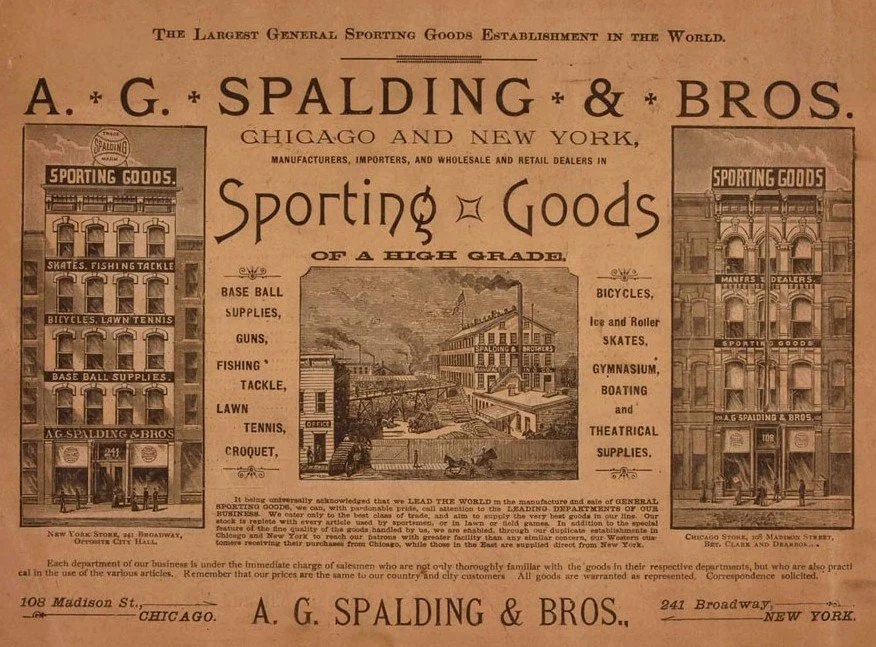
1885 Spalding Retail Stores and Hastings, MI Factory
In 1885, Henry Ditson of Boston-based Wright & Ditson passed away and George Wright, who was a former teammate of Albert Spalding on the Boston Red Stockings, approached Spalding to purchase Ditson’s half of the company, which Spalding did with Wright staying on the run the business.
After George Wright retired many years later, Wright & Ditson was being managed by his sons, Beals and Irving, who were both nationally prominent tennis players. When George passed away in 1937, Spalding purchased Wright’s remaining interest in the company from the sons and now owned the company outright.
In 1894, A.G. Spalding acquired Peck & Snyder of New York, which Spalding phased out in the ensuing years. However, they continued to offer the popular Peck & Snyder roller skates co-branded with the Spalding trademark until at least 1904.
Spalding’s next purchase was from another former baseball player turned sporting goods entrepreneur, A.J. Reach of Philadelphia. As a result, in 1889 he acquired all of the Reach’s retail stores for $100,000, while A.J. Reach maintained possession of his production facilities and brand name. Spalding eventually purchased the entire company in a series of transactions in the following years.
Soon after completing these acquisitions, Albert Spalding encountered a significant new problem in the form of the Sherman Antitrust Act of 1890, which prohibited business monopolies. He now had interests in the three largest American sporting goods manufacturers of the day and in order to avoid violating the Sherman Act, he judiciously avoided combining the companies, which actually worked out quite well for him.
In order to avoid manufacturing duplicity in the Spalding, Reach and Wright & Ditson product lines, it was decided that while all three companies would continue to market a complete line of sporting goods under their respective brand names, while each company would specialize their manufacturing to specific products.
It was decided that from that point forward, Spalding Bros. would primarily make golf clubs for all three companies, while Reach would specialize in baseball and football. Wright & Ditson, which advertised that they were “The Largest Maker of Tennis Supplies in the World” naturally was designated as the tennis manufacturer for the group.
As the years went by, Spalding Bros. branded an increasingly higher percentage of its sporting goods with the Spalding trademark. However, they continued to market Wright & Ditson tennis balls into the 1970’s and the Official American League baseball was Reach branded through 1976.
The Spalding company made its final acquisition in November, 1955 when they purchased Rawlings Sporting Goods, which was founded in St. Louis by brothers George and Albert Rawlings in 1887. Rawlings, while specializing in baseball, carried a full line of sporting goods, including tennis. After eight years Spalding was forced to sell Rawlings by government anti-trust lawyers, which they did by spinning Rawlings off to private investors in September, 1963.
The modern-day Spalding company phased out their tennis line, after almost 90 years of lawn tennis racket production, in the early 1970’s to concentrate on their more profitable product lines, such as baseball and football.
Wright & Ditson
In 1910, Wright & Ditson formed a marketing partnership with fellow Massachusetts company Victor Sporting Goods where the Wright & Ditson catalog would begin to include some Victor products. This eventually led to a “consolidation” between the two companies in 1918 where from that point forward all products produced by Victor were marked “Wright & Ditson – Victor”. This arrangement stayed in place until 1928 when Victor was fully assimilated into the Spalding family of companies and the Victor brand was retired.
The Victor Sporting Goods Company has its own interesting back story prior to its 1910 partnership with Wright & Ditson. It was founded by the Overman Wheel Company of Chicopee Falls, Massachusetts in 1894 as a result of a dispute with A.G. Spalding.
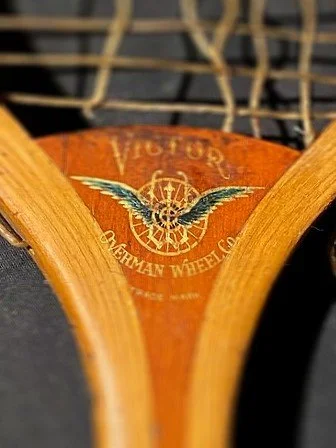
1895 Overman Wheel Racket
From 1888, when Overman was producing 80,000 bicycles a year and until 1893, Spalding was the sole distributor of the popular Overman Wheel Company’s “Victor” safety bicycle. In that year, the distributorship was cancelled due to a dispute and both companies filed lawsuits against each other.
As a result, Spalding opened their own bicycle plant down the road from Overman Wheel who responded by announcing they were going into the sporting goods business to compete with A.G. Spalding Bros.
And in 1894, the newly formed Victor Athletic Goods launched their own product line. A November 7, 1895 ad in Ann Arbor Courier states that among many items they offered were “tennis rackets, tennis balls, tennis sets and racket presses”.
One of the rarest American made tennis rackets is the first-year racket they produced that was stamped “Victor” and “Overman Wheel Co.” on the convex wedge that also included the Overman Wheel logo. Rackets from 1895 forward were stamped only with the Victor Sporting Goods mark.
In 1898, Overman Wheel was in financial trouble and, as a consequence, they sold off Victor Athletic Goods. The new owners changed the name to Victor Sporting Goods and all company operations were moved to Springfield, Massachusetts, where it prospered on its own until the 1910 partnership with Wright & Ditson and subsequent acquisition by Spalding Bros.
The P. Goldsmith Sons, Inc.
Phillip Goldsmith was an Austrian immigrant who arrived in the U.S. during the Civil War and settled in Covington, Kentucky, where he opened a toy store in 1869 specializing in dolls made by a local craftsman named Wolf Fletcher. In 1875, Goldsmith went into a partnership with Fletcher making toys and baseballs. The following year, the partners invented and patented a machine for winding the strings that go around the core of the ball that would change the way baseballs were manufactured.
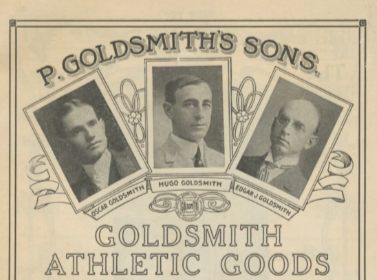
The Goldsmith Brothers Circa 1913
Goldsmith left the partnership in 1878 and founded a company that manufactured sporting goods and the Goldsmith Company became known as a maker of quality baseball goods and the business steadily grew.
While on a family vacation in Wisconsin in 1894, Phillip Goldsmith drowned leaving a void in the company management. His sons, Oscar, Hugo and Edgar stepped in to the run the company and changed the name to P. Goldsmith’s Sons while moving the entire company nine miles north across the Ohio River to Cincinnati.
The company continued to grow and add product lines like tennis and golf equipment. As a result of their ongoing success, they were a strong company financially. When the Great Depression, which lasted from 1929 to 1939, hit America and other sporting goods companies began to falter, the Goldsmith boys stepped up and bought Crawford, McGregor and Canby in 1936.
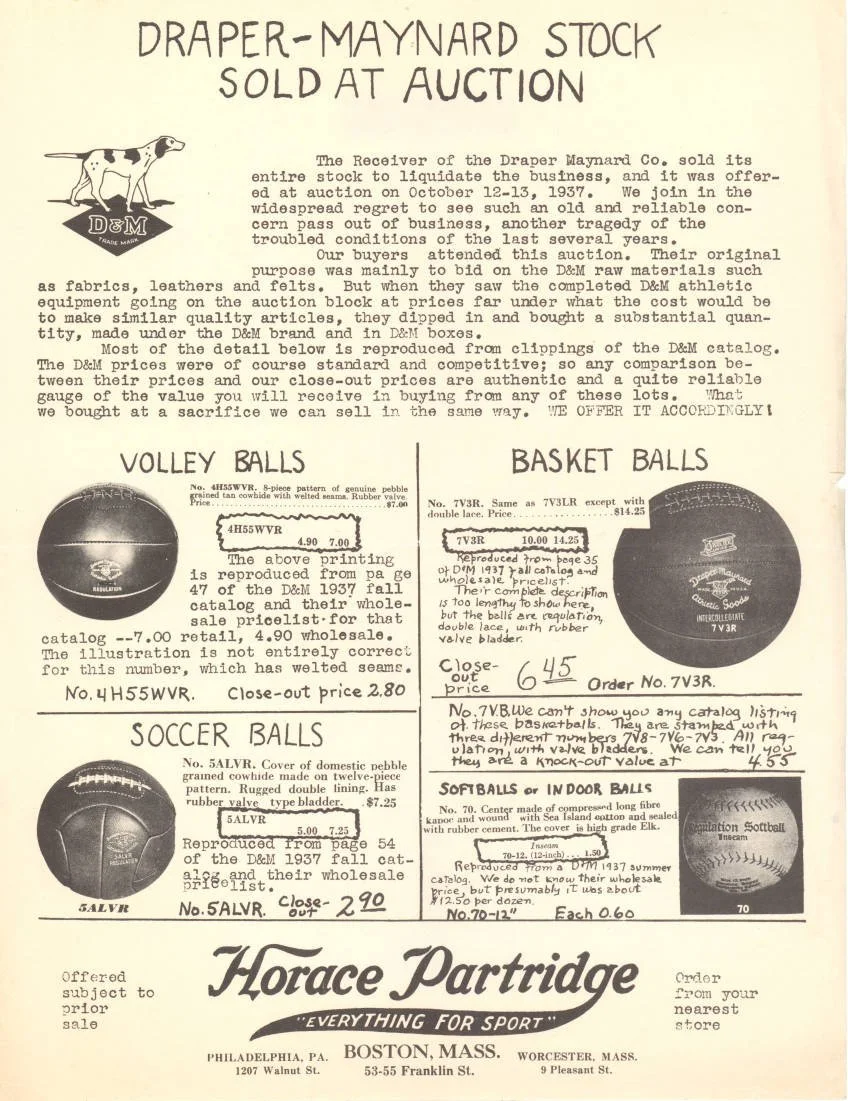
The following year they acquired Draper & Maynard of Plymouth, NH, which was assimilated into Goldsmith’s Cincinnati operations with the occasional use of the Draper & Maynard “Lucky Dog” logo through 1962. The inventory of the Draper & Maynard Co. was auctioned off on October 12 & 13, 1937 and the biggest bidder at the auction was the Horace Partridge Co, which at the time was owned by Wilson Sporting Goods. Ironically, the Horace Partridge Co. had also been owned by Draper & Maynard during a financial downturn from 1905-09. It gets complicated sometimes.
The Crawford, McGregor & Canby Company suffered a better fate than Draper & Maynard. They were famous worldwide for their high-quality golf equipment and much more well known than Goldsmith. Consequently, PGoldsmith Sons rebranded itself “MacGregor Goldsmith” in 1943 after adding an “a” to McGregor. In 1953, they went a step further and changed their name to simply MacGregor.
While P. Goldsmith’s Sons was a full line sporting goods company with well-known rackets like the Lady Claire bulbous handle racket and Babe Didrickson endorsed rackets, MacGregor was a golf only company when purchased in 1936. By 1949, a line of tennis rackets was made under the MacGregor trademark. MacGregor sold its first Sarah Palfrey Cooke photo decal racket that year, which was followed by the Frank Parker photo decal model in 1950. MacGregor remains in business today, but has switched back to golf products only.
Wilson Sporting Goods
The Ashland Manufacturing Company, which was the predecessor company to Wilson Sporting Goods, was originally set up as a subsidiary of the large meat packing company Schwarzchild & Sulzberger, which originated in New York. In 1900, they moved to Chicago where they constructed a large meat packing plant in Chicago on Ashland Street, which was regarded to be the best state of the art plant in the world
In 1910, the company was renamed Sulzberger & Sons after they bought out Schwarzchild. In 1913, they established a subsidiary, the Ashland Manufacturing Co., to actively seek new ways of using the slaughterhouse byproducts from their meat packing plants. The parent company had been marketing violin strings, surgical sutures, and racket strings made out of sheep gut since 1898.
In 1915, a New York banking group called in Sulzberger & Sons loans, due to the fact that the company had been supplying Germany with meat products during WW I, which forced them into bankruptcy. The bankers set up a new company with the Sulzberger assets and renamed it “Wilson and Company” after the popular president Woodrow Wilson. Coincidentally, the meat packing executive who they hired to run the company in 1915 was named Thomas E. Wilson.
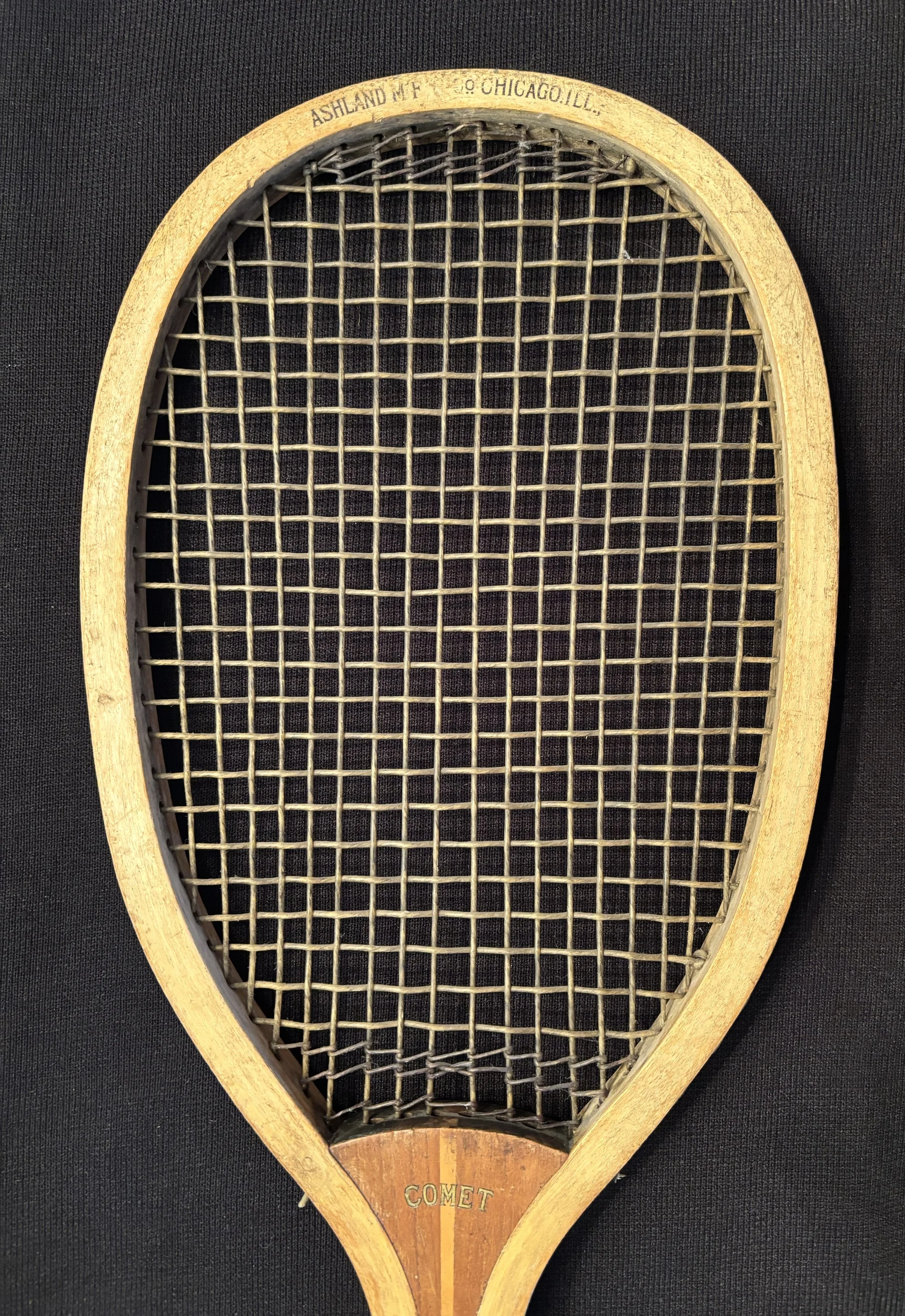
Circa 1915 Ashland Comet Racket
Thomas Wilson initially decided that sporting goods was not the direction he wanted to go with the company and, consequently, offered fellow Chicago company A.G. Spalding & Bros. a chance to purchase Ashland. When Spalding’s offer was deemed insulting and insufficient, Wilson decided to reverse course and grow Ashland into a Spalding competitor.
Before Thomas Wilson joined the company, Ashland had begun selling a limited sporting goods line in May, 1914 that included tennis rackets, baseballs, and baseball shoes. Ashland had an early racket production agreement with E. Kent of Pawtuckett, RI, which continued when the name was changed to Wilson into the 1930’s according to E. Kent in one of his catalogs. Ashland offered dozens of racket models in it’s 1916 catalog, which would have been impossible without Kents assistance and many of the Ashland models had the same name as Kent rackets, such as the Lenox and the Powelton cork handle model.
Pre-Wilson rackets made by Kent for Ashland starting with the 1915 “Star” model and all Ashland marked rackets from 1916 forward had Ashland double circle logo (which looks suspiciously like the Spalding logo), except the very first rackets that were actually made by Ashland, which are very rare, have “ASHLAND MFG. CO. CHICAGO, ILL” stamped on the top of the head.
The Ashland product line expanded dramatically from 1915-1917 adding products such as golf clubs, footballs, basketballs, and boxing gloves to their tennis and baseball product lines. By 1917, Ashland was offering a full-line sporting goods catalog to the public and in February of 1917, the Ashland name was suddenly changed to Thomas E. Wilson & Co. Initially the advertising for Ashland and Wilson was co-branded, until customers became more familiar with the Wilson name.
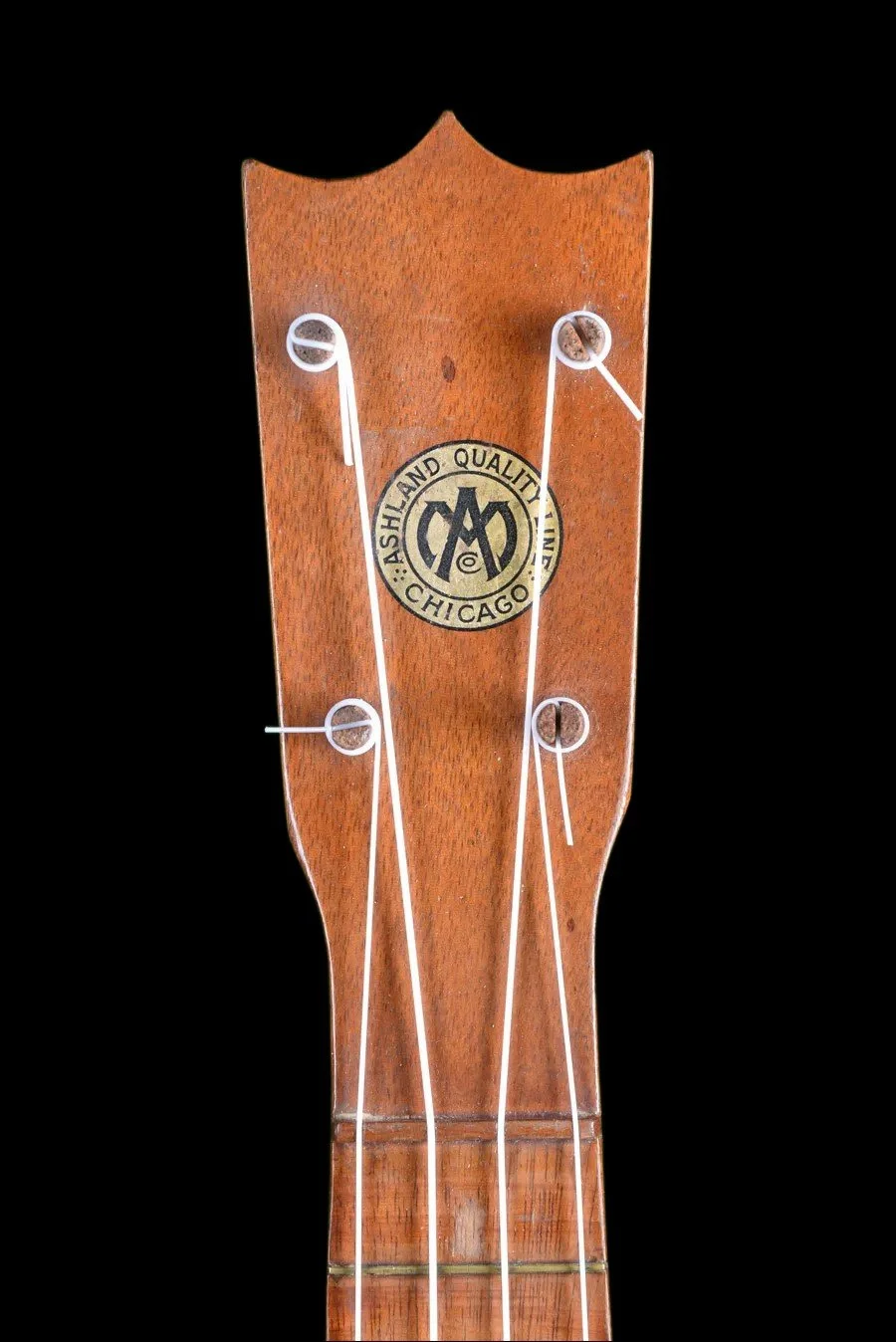
1917 Ashland Ukulele
Apparently, company management lacked a little focus while building the initial Ashland product line. For example, in 1917 they advertised a line of “Wilsonian” phonographs and Ashland ukuleles for Christmas presents, as well as offering auto tires. In 1918, Thomas E. Wilson & Co. advertised Wilson branded food products, such as Wilson’s ketchup and chili sauce. By 1920, they got back on track when they purchased the Chicago Sports Equipment Manufacturing Company, who specialized in baseball equipment and uniforms, to build their product line leaving all non-sports products behind.
While they did make their own limited production rackets, most wood Wilson rackets were made by other manufacturers for their entire wood racket history, as evidenced by their Kent connection. Amazingly, I read that over time that the Spalding organization made more Wilson rackets than Wilson did! Other possible suppliers that were active in contract manufacturing were Bancroft and the Magnan Company.
Despite their limited production capabilities, Wilson did occasionally make rackets for other companies. Wilson made a Suzanne Lenglen racket for the Winchester brand in 1927, as well as a Lenglen model for their own catalog. In the 1930’s, Wilson used a DuPont patented “Duco High Polish Finish” racket varnish on their in-house rackets. When you encounter a racket with that verbiage on the side of the handle, rest assured that it was definitely made by Wilson.
In 1923 Wilson formed a marketing alliance with Western Sporting Goods, which spawned a new name for the company, Wilson-Western Sporting Goods. The companies were merged together and that name was used until 1931 when the final name of Wilson Sporting goods Co. was adopted and is still in use today.
Wilson was an early leader in marketing endorsed tennis rackets signing Maurice Mcloughlin to a signature racket contract in 1917 and then Ellsworth Vines to appear on one of the first photo decal rackets in 1934, In the same 1934-35 time frame, Wilson also produced nearly identical Henri Cochet photo decal rackets with both the Wilson and Chicago Sports Equipment trademarks, as well as a Cochet tennis ball can and a May Sutton Bundy signature racket both by Chicago Sports Equipment. These are the only known instances of that trademark being employed for a tennis product after the 1920 acquisition and it is unknown why Wilson decided to briefly use the trademark after 15 years of dormancy.
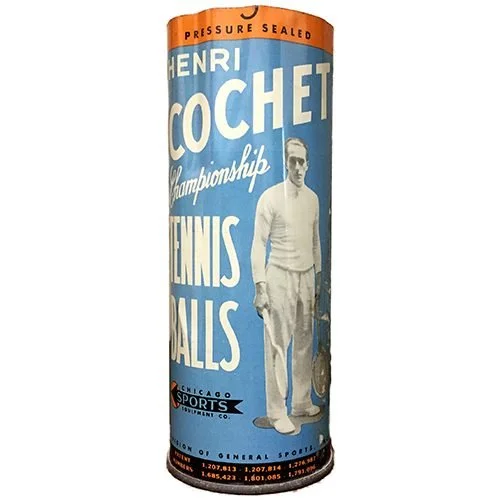
Circa 1935 Chicago Sports Equipment Cochet Tennis Ball Can
The Great Depression of 1929 to 1939 had a negative impact on Wilson’s sales, but they were strong enough to weather the economic turmoil and to take advantage of it by acquiring two struggling companies in 1931, Lowe & Campbell Athletic Goods of Kansas City and the Horace Partridge Co. of Boston. Lowe & Campbell, a midwestern chain, was allowed to continue to operate independently until 1961 when they were fully absorbed by Wilson. Horace Partridge, an early maker of tennis rackets who once had European stores in Paris and Frankfurt, was folded into the Wilson operations shortly after it was acquired.
After essentially ceasing sporting goods manufacturing to make war supplies during WWII, Wilson continued to grow its post-war market share and to maintain its position in the tennis market, despite the fact it still didn’t actually produce most of its Wilson branded tennis rackets. This came to a head in 1962 when Spalding informed Wilson that they would no longer make rackets for them.
Wilson, in turn, decided to acquire another one of its other contract manufacturers, the Cortland Racquet Company of Cortland, New York, to help fill the lost Spalding wood racket production. Cortland Racquet, which was a division of the Cortland Line Company, didn’t have sufficient production capacity to totally fill the shortfall, but Wilson managed to produce enough rackets among its suppliers to get through until 1967 when the wood racket killer - the steel T-2000 hit the market. That was the beginning of the end for the wood racket that was last produced in 1985 after losing market share every year to steel, aluminum and composite rackets. Shrinking wood racket demand alleviated Wilson’s wood racket shortfall and they converted the Cortand plant to T-2000 production, as well as finding other domestic manufacturers to make the new innovative steel rackets.
The list of companies that are mentioned in this article was whittled down through atrophy and acquisition to only four at the end. Wilson Sporting Goods, the only company that is still in the tennis business, got there by employing an uncannily successful combination of acquiring other racket makers and juggling racket production, internally and with contract suppliers, to meet the demands of their market in what is a classic study in production management.
Good Collecting