John Wilkinson 1880 Chicago Racket Maker
First Published December, 2025
John Wilkinson was born a child of privilege to parents, John Sr. and Henrietta, in Syracuse, New York in the year 1840. His father, a railroad president, was a man of influence in the area to the extent that he was the person who actually chose the name “Syracuse” for the city. John Jr. was educated in Syracuse and at the Polytechnic Institute of Brooklyn culminating in a law degree, after which he took a two and one half year tour of Europe.
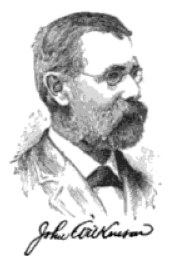
However, after returning from Europe and despite all the advantages available to him in Syracuse, John headed west at the age of 25 to make his own way in Chicago. In 1867, he partnered with Josiah Parkhurst to establish the firm of Parkhurst & Wilkinson who were wholesale dealers in hardware, iron and carriage components. Their trade grew rapidly and by 1871 they were one of the largest U.S. wholesalers in their category. Then the Great Fire of 1871 swept through Chicago destroying 17,500 structures, including properties owned by Parkhurst and Wilkinson. Obviously, it was a setback, but the company rebounded well and continued to grow.
While maintaining his business partnership with Parkhurst, Wilkinson set up a separate enterprise in 1872, which did business as the “John Wilkinson Company”. His primary initial products that he sold through catalogs and ads were treadle powered scroll saws and lathes. He then added woodworking to his product line and boosted sales by authoring a book on the subject that sold 120,000 copies. Photography, which was still evolving, was his next product addition and he built one of the largest private photography studios in the country to support product development.
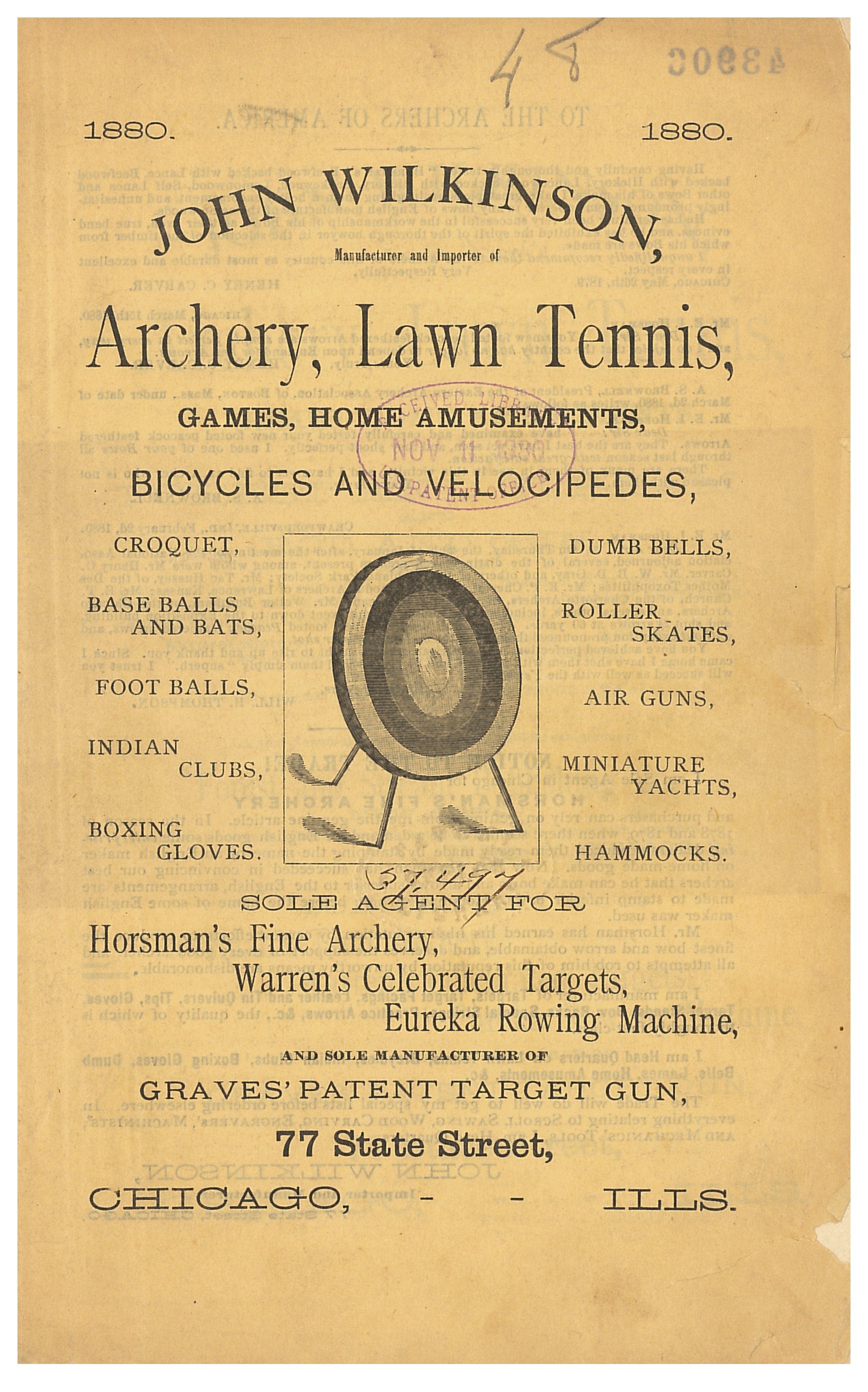
Cover of 1880 Wilkinson Catalog
In the mid-1870’s Wilkinson took up archery, which along with croquet were the current popular sports sweeping through Europe and the United States, and he became quite accomplished at the sport. In fact, at a national competition in 1882, he won the “Flight Shoot” event by shooting an arrow 213 yards with a longbow.
As a result of his interest in the sport, his company contracted to become the “Western Depot for Horsman’s Celebrated Archery” beginning on March 1,1879. In addition to adding Horsman’s archery products, Wilkinson also added John Blake, who had been E.I. Horsman’s right hand man, to his organization in 1879. Blake had helped Horsman build his sporting goods empire in New York from the very beginning and as the new Vice President of the John Wilkinson Company, his job was to do the same for Wilkinson in Chicago.
Once they brought Blake on board, the John Wilkinson Company began ramping up their sporting goods offerings by adding baseball and archery equipment to their 1879 advertising. Blake undoubtedly used his Horsman supplier connections to add new sports, such as football, boxing, fishing and croquet to their initial sporting goods catalog first published in 1880, which featured lawn tennis and Horsman’s Fine Archery. The 1880 catalog also introduced “The Wilkinson Bicycle”, a large front wheel bike that was being produced by Parkhurst & Wilkinson who also supplied steel to other midwestern bicycle manufacturers.
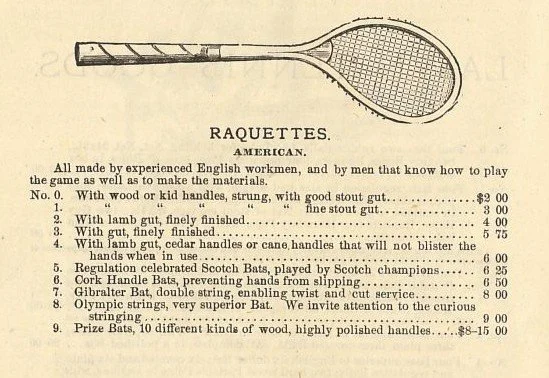
1880 “Raquettes” from Wilkinson Catalog
It is the fact that Wilkinson offered lawn tennis equipment in their 1880 catalog that presents a definite quandary about who actually made the 1880 Wilkinson rackets. The assumption among tennis researchers has always been that Horsman made Wilkinson’s rackets from the very beginning. This makes sense, because it is known that Wilkinson had a prior relationship with Horsman through archery, that Blake moving from Horsman to Wilkinson provided a connection between the two companies and that nine of the ten rackets in the 1889 Wilkinson catalog are branded Horsman models.
However, after doing extensive research, I do not think that any of the rackets in initial 1880 Wilkinson catalog were made by Horsman. The primary reason is that when I compared the rackets in the 1880 Horsman catalog and the 1880 Wilkinson catalog I found very few commonalities between the two company’s racket lines.
In previous research that I did for my “Early American Racket Makers” booklet published in 2019, I established that the earliest confirmed year of Horsman racket making is 1880. The 1880 Horsman catalog offers nine tilt top lawn tennis “bats”. Six of them were made in England, including the Marylebone, Henry V and Alexandra models. Three tilt tops are Horsman branded, including the Match Bat, Double Strung Bat and Double Strung Extra Bat, which was a very expensive racket in 1880 at $10.00.
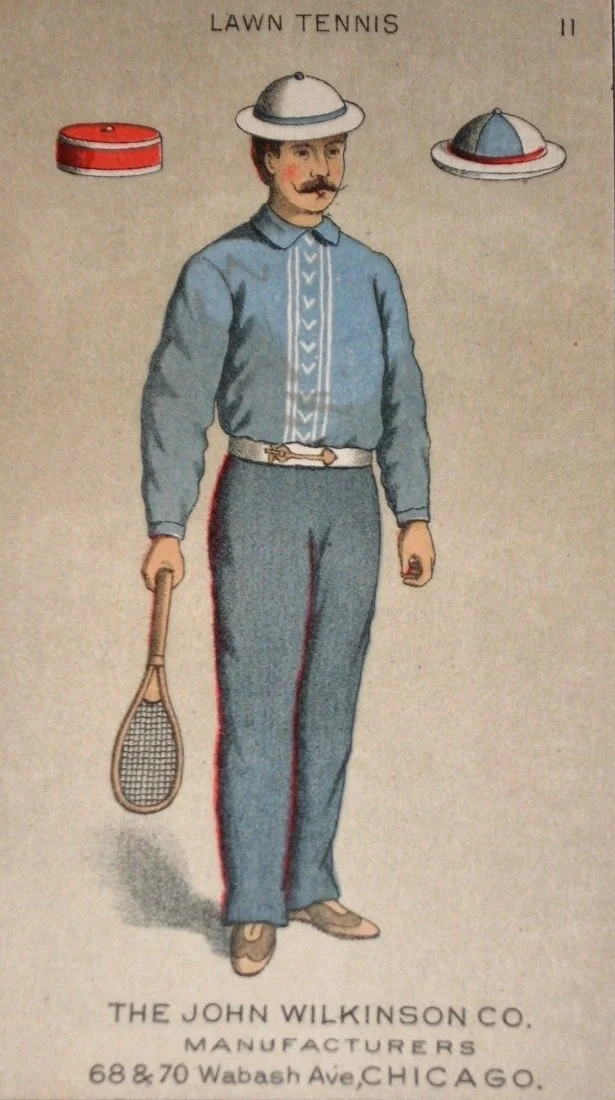
Illustration from 1883 Catalog
The 1880 Wilkinson catalog offers ten tilt top model rackets accompanied by a tilt top racket illustration. All of them are “American Raquettes” made by “experienced English workmen” according to the catalog. Their No. 7 Match Set is hailed as “The finest American set ever made”. The fact that the two companies use different terms, “bats” and “raquettes” to describe their rackets also indicates that the rackets had different makers.
A final point of comparison is between my pictured early 1880’s Wilkinson and Horsman lawn tennis boxes, which shows that they were made by different companies. Not only do the boxes have different dimensions and interior configurations, they are constructed quite differently. As you might expect from a company that also sells woodworking supplies, the Wilkinson box has superior construction and hardware. The corners of the Wilkinson box are interlocked with finger joints, while the Horsman corners are simply two boards nailed together. That definitely points to two completely different lawn tennis box makers.
The question then arises “If not Horsman, who made the Wilkinson rackets?” If we accept that they are American made, as the Wilkinson catalog states, there are very few candidates. They only confirmed pre-1880 American mass market racket company is D.W. Granbery of New York who began making their own rackets in 1878. It is unlikely that Granbery had built up their production capacity enough in two years that they could supply a company 800 miles away with sufficient inventory and also produce enough rackets for their New York market, as well.
That leaves us with the one final option that these 1880 rackets were actually made by the Wilkinson Company. John Wilkinson was a businessman, not an early racket maker like John Cunningham, so like Horsman and Frank Slazenger, Wilkinson brought in experienced English craftsmen to produce his initial rackets and to train his American employees in the art of racket making. Perhaps they were hired from England, but more likely these were English racket makers living in New York that had previously worked in the industry and were known to Blake. In terms of setting up a racket making shop, it certainly would not be difficult for a company that also deals in industrial machinery and hardware to do so.
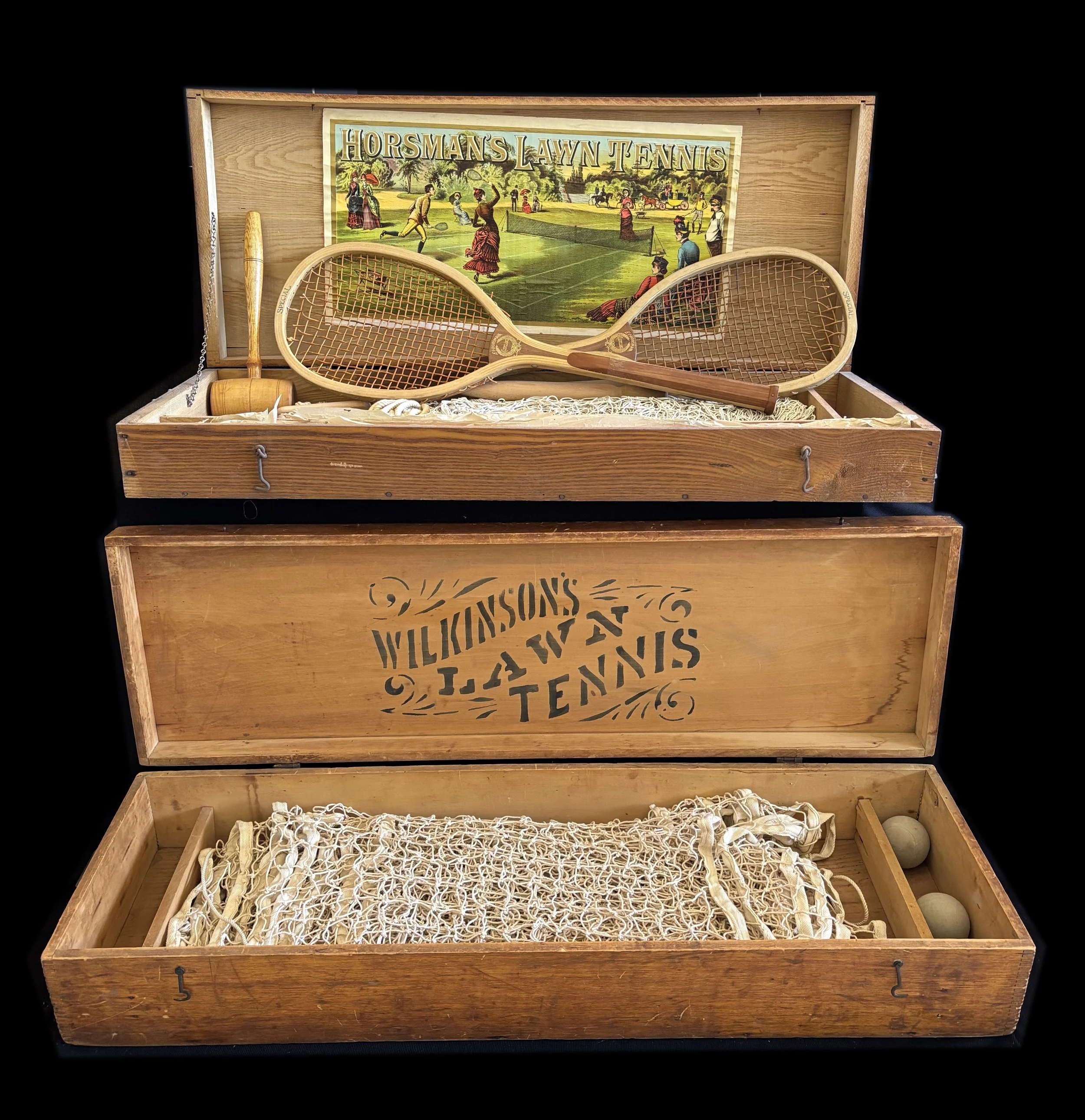
1880’s Lawn Tennis Boxes
Wilkinson marked rackets are quite difficult to find, one reason being is that it appears that Wilkinson didn’t put his makers mark on his early boxed set rackets or the American rackets offered in the 1880 catalog. The catalog only has descriptions of each racket’s characteristics without any individual model names. However, in the 1889 catalog they offered a top of the line marked racket with the model name “The Wilkinson Ideal” (probably made by Horsman by that point in time), in addition to the nine previously mentioned Horsman marked rackets. I suspect that at some point in time between 1880 and 1889, Blake and Wilkinson decided that making their own rackets wasn’t worthwhile and they switched to offering only Horsman made rackets in their catalogs.
Wilkinson’s business in Chicago encountered a rather substantial competitive headwind in A.G. Spalding & Bros who launched their Chicago based sporting goods business in 1876 and began selling imported English lawn tennis equipment in 1878. Spalding had the advantage of the founder’s famous name and contracts to supply equipment to professional baseball leagues to give it startup momentum.
Growth for Wilkinson came more through their mail order catalog and publication advertising. The company moved to larger buildings in 1883, 1889 and 1892 in downtown Chicago and went through three name changes with the final name The Wilkinson Company adopted in 1893.
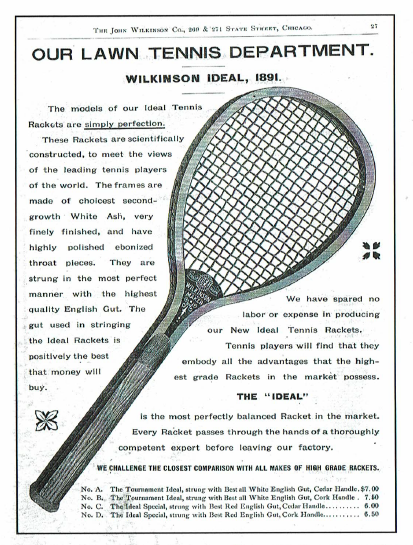
1891 “Wilkinson Ideal” Catalog Ad
Parkhurst and Wilkinson, despite being one of the largest hardware and carriage wholesalers in the country, declared bankruptcy in 1893, but continued to operate into 1903. John Wilkinson divested himself of his shares in the company and when the company incorporated in 1897, he was no longer associated with Parkhurst and Wilkinson.
The advertising for The Wilkinson Company moved away from sporting goods, except for a very large fishing department. The final ad that my research discovered is from 1896 and offers only fishing and photography equipment, in addition to Wilkinson bicycles. That 1896 ad is the last mention that I could find for The Wilkinson Company, it simply faded away.
In the same year of his last ad, Wilkinson and his son founded The Hope Chemical Company, which sold medicines to doctors through mail order. They continued in the chemical business until 1904, when John Wilkinson passed away indirectly due to his avid pursuit of archery. On September 9, 1904, Wilkinson was making archery targets in the loft of the barn behind his house when a fire broke out on the main floor trapping him in the loft. As a result, he was severely burned and taken to a hospital where he died three days later.
Absent of any additional discoveries, John Wilkinson, is the first known racket maker outside of the Philadelphia-New York-Boston corridor to produce tilt top lawn tennis rackets in the U.S. His passion for archery led him to emulate E.I. Horsman’s business model as a sporting goods retailer. While he was not as successful as Horsman in the long run, John Wilkinson, through his store in Chicago and his national mail order catalog, played an important early role in helping the game of lawn tennis spread from the East Coast to the Midwest and beyond.
Good Collecting.